Materials Bank

Over the years I have come across a number of innovative materials which are disrupting the construction industry in the best way possible. The below is a live list of those materials, to be updated continously to become an informal ‘materials ideas bank’.

I have been fortunate enough to use a number of these on projects, which I have highlighted below with an asterisk.

CompanyProductInfoLocation
Clayworks*Clay PlasterNatural clay plasterCornwall, UK
AdaptavateBreathaboardCarbon Negative plasterboard alternativeBristol, UK
X-FrameCircular Wall Framing SystemFully demountable and reusable alternative to partitioning systemsAustralia (but scaling to be worldwide manufactured)
BauxWood Wall Acoustic PanelsWood wool, cement and water panelsSweden
Foresso*Timber terrazzoTerrazzo made with waste timber offcutsLondon, UK
Hemp BlocksHemp BlocksConstruction blocks made of hemp fibreUK
Eco Friendly Tiles*VariousVarious tiles made of high recycled content and circular tilesVarious
FrontWastebased brickBricks made with waste bricksNetherlands
FrontCornWallInterior wall panelling made of bio based wasteNetherlands

What does wellbeing ‘feel like’?

Can you feel whether a building is good for your health? Whilst ‘feeling’ whether a building is good for your health could be considered intangible, it is well documented (with its own page on the NHS website[1]), that ‘sick building syndrome’ is a condition that can have severe health impacts[2]. There is no defined or understood cause of Sick Building Syndrome other than assumptions that it could be to do with poor ventilation, off-gassing of materials or poor lighting amongst others. Therefore, if we can experience ‘sick building syndrome’ without known cause, by default we must be able to feel and experience the opposite ‘healthy building syndrome’ if you will, which would be defined as a building that can improve your wellbeing and health.

So in the context of ‘healthy building syndrome’ what is wellbeing? The World Health Organisation define wellbeing as the following:

Well-being is a positive state experienced by individuals and societies. Similar to health, it is a resource for daily life and is determined by social, economic and environmental conditions. Well-being encompasses quality of life and the ability of people and societies to contribute to the world with a sense of meaning and purpose. Focusing on well-being supports the tracking of the equitable distribution of resources, overall thriving and sustainability. A society’s well-being can be determined by the extent to which it is resilient, builds capacity for action, and is prepared to transcend challenges.’ [3]

Therefore, it can be summarised that in the context of building design:

  1. Wellbeing can be felt as a ‘positive state’
  2. Wellbeing is determined by environmental conditions

We know that we can use design to certain targets to achieve optimal comfort, health and wellbeing. These are defined most typically by the BCO Guide to Specification which defines the healthy targets for humidity, temperature etc. which are further enhanced by the WELL Building Standards criteria for Air such as ‘A01.1 Meet Thresholds for Particulate Matter and A06.2 Improve Ventilation Effectiveness’ amongst others. Meeting these criteria should make for a healthy building.

Further enhancements are through the Daylighting and Material features, ensuring products have very limited off-gassing, chemicals etc. and chemicals are limited/removed in the operation and maintenance of the building.

However, when it comes to look & feel and how a space is perceived, material selection and visual representation of wellbeing is just as important as the technical aspects detailed above. WELL therefore also encourages use of natural materials, biophilia and views of nature through the Mind and Materials features.

And whilst trends in office design are incorporating those features, how do we keep the ‘feeling’ of a healthy building fresh, innovative and exciting? Listed below are 5 examples of materials that can be used in office design to meet the Mind and Materials features, whilst being interesting and innovative:

The Black and White Building

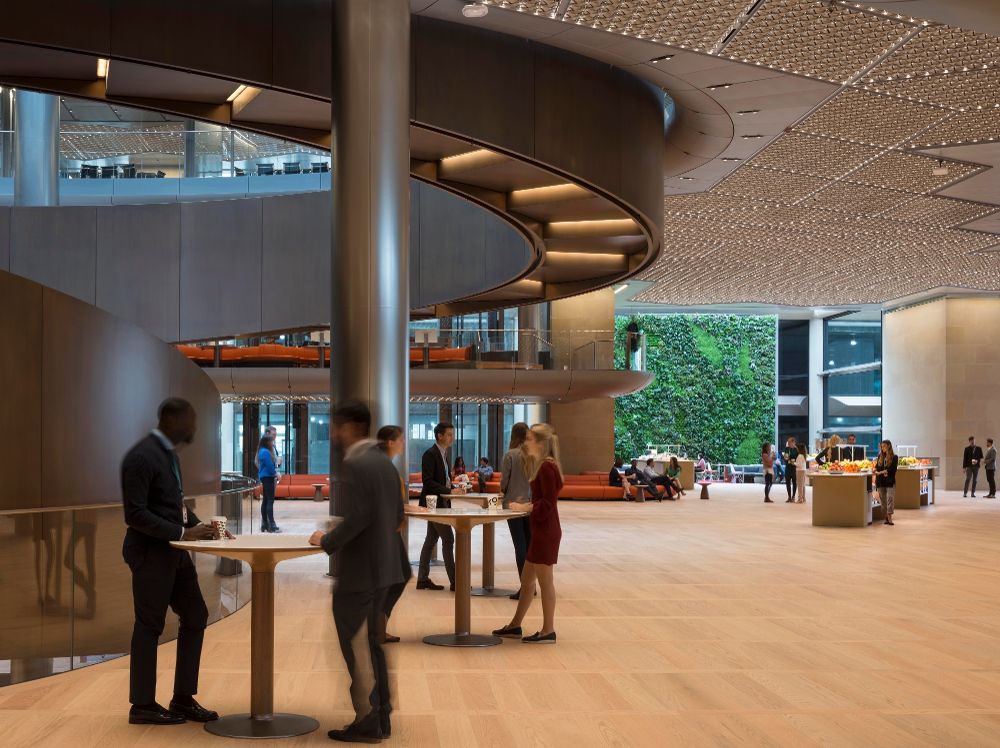
One building in particular which has employed some of the above (plus other materials such as timber) have been very successful in the London office market, is The Black and White Building which imparts a sense of calm, meditative and restorative space despite being located in the heart of Shoreditch, London. This is further enhanced by the sense of craftsmanship (therefore lack of adhesives) that make this building feel crafted and cared for, again contributing to a sense of health & wellbeing.

In summary, designers should ensure that as many of the WELL credits are targeted to achieve a healthy building, over and above the BCO guide. However ‘healthy buildings’ don’t need to be caricatured by being a building covered in timber and pot plants to make it healthy, it’s about the intangible as well as the tangible. And typically when high-quality, natural, crafted materials are used they not only look better and maintain better they will likely last a lot longer too.


[1] https://www.nhs.uk/conditions/sick-building-syndrome/

[2] https://www.ncbi.nlm.nih.gov/pmc/articles/PMC2796751/

[3] https://www.who.int/activities/promoting-well-being

How can material specification help achieve Net Zero targets?

I was recently invited to be a panellist as part of Building Magazine’s Net Zero live event in May 2022. The hour panel was on the topic of how material specification can help achieve Net Zero targets, with a really interesting cross-sector discussion from myself, a Structural Engineer and a Developer.

Follow the link below to read my summary of the event, and a link to watch the panel itself!

Does designing for wellbeing contribute to more sustainable buildings? Part 3

Part 3. The Wellbeing Brief. What is it and how could it help you or your building?

WELL does many things well (pun very much intended), it sets out rigorous evidence based targets and it provides a process and methodology for tracking and proving those outcomes. Whilst this is successful in its own way, I would propose that there is a fantastic opportunity in going beyond this, as explored in Part 2.

As a commercial architect working on commercial projects, I have often been asked to design and implement using ‘WELL Principles’, a phrase that is not endorsed by the WELL Building Standard or IWBI. Often requested where it is too onerous and too expensive to pursue WELL certification, the design team is often asked to use the principles of WELL throughout the design of the building, producing a summary to document how the principles of WELL have been met.

Whilst this is fairly easy to implement, there is no real evidence, tracking or quality control on the level of wellbeing designed into the building, therefore the wellbeing offering can vary massively.

Therefore, as introduced in Part 2, The Wellbeing Brief answers this request with a much more robust and evidence-based methodology, targeting a real wellbeing offering which meets the building occupiers needs and goals with a documented process. Therefore, contributing towards better designed buildings and more sustainable buildings from the outset, with a level of quality assurance.


The Wellbeing Brief

Decision

A decision is made by the building owners or occupiers that a building or space should be improved to provide a great wellbeing offer.

Goals

The decision-making team meets with the relevant stakeholders to determine the specific wellbeing offering they want to provide, why they want to offer it and what does that look like.

Targets

Based on these goals, specific evidence-based targets would be designed to provide quantitative or qualitative measures to assess these goals by and assess whether the goal has been successfully reached, or whether more work is required to get there.

Scope

These wellbeing goals in the form of evidence-based targets would then form part of the original brief to be implemented into the design teams briefing.

Tracking

Key project stages (kick-off, planning, implementation as a minimum) would be targeted as opportunities to review the project progress and whether the goals are being worked towards and implemented. If not, then the review would look at why these aren’t being targeted and whether the approach needs to change, keeping the process fluid and responsive rather than rigid and immovable. This would continue throughout the project until practical completion.

Reporting

At practical completion, the final assessments and gathering of evidence against the evidence-based targets would be collated and a report produced with the above documented. This report would form a tangible and evidence-based document, demonstrating how a good wellbeing offer has been provided. This can be used for marketing purposes, for sales and letting opportunities or for signalling to tenants that a robust wellbeing offer is in place.

Post-occupancy evaluation

To ensure the good wellbeing offer is maintained, ongoing wellbeing focused POE would be carried out once the building or space is occupied to ensure any ongoing goals are being met.


At the conclusion of this 3 part post discussing wellbeing, sustainability and implementation, it is clear that there should be a choice of paths available when implementing high quality wellbeing offering; dependent on the goals, the budget and the desired outcome. WELL is fantastic for many projects, and will continue to develop to meet the current trends (as it has with the Health & Safety Rating in response to Covid and in the simplification of some of its requirements). However, there is still certainly room for a less onerous and more holistic approach, which expands on some of the themes not fully explored by WELL.

What is important however, as demonstrated by the flowchart in Part 2, is that considering this early on is the key to ensuring decisions are made holistically with the sustainable targets also in mind.

I’d be interested to know your thoughts on whether the wellbeing brief approach outlined above would be something you’d be interested in, or whether you’ve used different approaches and how they’ve worked out.

Does designing for wellbeing contribute to more sustainable buildings? Part 2

Part 1 of this blog post explored how designing for good wellbeing in our buildings can contribute to better, more sustainable buildings and even towards achieving Net Zero Carbon targets. Whilst good wellbeing design doesn’t necessarily equal good sustainability, it is one of many components which are required to be considered at the outset if we want to build well used buildings with longevity.

Part 2 explores the technical aspect; how do we design for good wellbeing from the offset, track it throughout the design, construction process and lifetime of the building, and ultimately how do you even measure it?

The WELL Building Standard (WELL) and other wellbeing certifications are the obvious answer to this. WELL provides a robust, scientifically and research backed standard that provides the practical methodology and the evidence based targets in designing for good wellbeing, with an internationally recognised certification. It was the first standard of its kind, launched in 2014 when wellbeing within the built environment was largely intangible and difficult to measure. WELL v2 was launched 4 years later in 2018 and provides a route very similar to BREEAM or LEED, where the project is registered at the start, a target is set and the design team can start using the principles (up to 108 of them) over 10 concept areas (Air, Water, Nourishment, Light, Movement, Thermal Comfort, Sound, Materials, Mind, Community, Innovation) to inform the design and track progress. At project completion, the project is assessed by a third party and certification awarded (Bronze, Silver, Gold, Platinum), with ongoing monitoring required and recertification every 3 years to ensure the building is still maintaining its wellbeing offering. 

However, WELL and other certifications aren’t the only way and they certainly don’t tick all the boxes for every project wanting to provide a great wellbeing offering.

Achieving WELL certification on your project can be expensive and that needs to be considered across the construction phase and lifetime of the project. Fig. 1 demonstrates the approximate costs a for a UK project of 1000m2 under WELL v2 certification.

Item$USD£GBP
Enrolment fee$2500£1860
Program fees$6500 ($1.208/ft2)£4835 (£0.90/ft2)
Performance testing$7250£5395
Total$16,250­­­£12,090
Construction uplift+ $4-11/ft2+ £3-8/ft2
Fig. 1. Table with approximate costs for initial registration and fees for a 1000m2 WELL V2 project in the UK.

Furthermore, the commitment and constraints can be overwhelming and might not be suitable for all projects. I also believe that WELL misses out detail in other important wellbeing aspects such as social value and inclusivity, therefore a more holistic view could be much more beneficial.

So to answer ‘how can wellbeing be integrated at first principles, and successfully implemented throughout in order to meet the wider sustainability goals’? WELL very much provides that in a nicely packaged solution.

However, if you didn’t want to go for a certification or didn’t know what was best for your building and your goals, what are your options? How can you bring in some dedicated expertise, track meaningful wellbeing implementation and provide a real, evidence-based wellbeing offering in your building, whilst also meeting the wider sustainability targets?

To help visualise this, the flowchart below demonstrates how and when you could engage with wellbeing at first principles to ensure a good wellbeing offering.


Fig. 2. Wellbeing Flowchart. When and how can you integrate wellbeing into your project?

So how does one implement good wellbeing at first principles, in order to contribute to a sustainability designed building? As shown in the flow chart I believe there are 2 paths available – WELL and other wellbeing certifications or a more fluid, holistic wellbeing brief. Both have clear benefits in improving the wellbeing offering of buildings, however being able to choose from multiple approaches allows flexibility on how that is implemented and what those specific focuses are.

Part 3 of 3 will go into more detail on how a wellbeing brief could provide the outstanding wellbeing offering, without the need to use WELL.

Does designing for wellbeing contribute to more sustainable buildings? Part 1

Wellbeing and sustainability. They’re grouped together the majority of the time, but does designing for great wellbeing genuinely contribute to more sustainable buildings, or is it a distraction from the big issue of trying to reduce the embodied and operational carbon in our buildings to get to Net Zero Carbon by 2050, with the mid-way target of 2030 fast approaching? 


In order to design a sustainable building we want to ensure what we are building is not negatively impacting the environment. The big target for the built environment is achieving Net Zero Carbon; there are various targets and pledges which the industry can and is using and is committed to in order to achieve this goal – LETI, The RIBA 2030 Climate Challenge and The Net Zero Carbon Buildings Commitment by the WGBC to name a few. Achieving Net Zero Carbon by 2050 is non-negotiable, the built environment sector ‘is globally responsible for 36% of energy consumption, 38% of energy related carbon emissions, 50% of resource consumption, and expected to double in total footprint by 2060.’ 

[The built environment] is globally responsible for 36% of energy consumption, 38% of energy related carbon emissions, 50% of resource consumption, and expected to double in total footprint by 2060

World Green Building Council


So in very simple terms to get to Net Zero Carbon, we need to reduce the embodied carbon of the building we are designing through careful selection of low embodied carbon materials and processes; ensure the operational aspects are as low carbon as possible, and whatever carbon remains can be offset by planting trees to sequester the carbon. For a less simplified version, refer to this graphic and explanation produced by OneClickLCA.

So where and how does wellbeing sit within that? This post will now explore how designing for good wellbeing, as well as the target on Net Zero Carbon will inevitably lead to healthier buildings, happier people and buildings which last for a longer time. 


A building which is great for wellbeing does not automatically equal great sustainability and vice versa. For example, a building could be the most comfortable space with high specification lighting, materials, furniture and finishes, have great amenities, be very inclusive and generally be an all round great space to be in. However, this could all be achieved with poor environmental performance, high energy consumption mechanical systems to keep the building at optimum temperature, finishes and furniture shipped from the other side of the world and materials which require high energy processes to manufacture them. This could be compounded further if the decision to design for great wellbeing was added in towards the end of the construction programme, and therefore many of these aspects had to potentially be shoe-horned in, with perfectly adequate materials ripped out and replaced and lots of waste created.

A building which is great for wellbeing does not automatically equal great sustainability and vice versa.


On the other hand i’m sure you can imagine that you could create a building of the latest low carbon or even carbon negative materials and technologies, powered completely from renewable sources to provide a truly sustainable building which has had zero impact on the environment, even including the end of its life where every component is either reused, recycled or simply biodegrades. However, this could also be an incredibly uncomfortable building, with poor thermal comfort, poor lighting and not very accessible therefore not lived in or used and has to be pulled down and replaced. 


So as always it’s about balance. Whilst designing for Net Zero Carbon is vital, we also have to ensure that the building is still meeting the other targets of profitability, comfort, 21st century living and of course great wellbeing. 


These things all need to be considered early on and included with first principles. A building which is great for wellbeing can also contribute to Net Zero Carbon design. 10 examples based on the WELL Building Standard features have been given below, however many more can be identified:

PrincipleAn example of good wellbeing designHow does that contribute to low carbon design?
AirHigh quality internal air which does not exceed optimum levels of particles, VOCs and CO²High quality internal air equals a healthy building which occupants enjoy being in, therefore contributing to the longevity and success of the building occupation
WaterWell designed watertight buildings to reduce any water damage or internal mould growthNo water damage means no need to use additional resources to repair or replace damaged materials
NourishmentEducation on and offering of healthy and nourishing foods which are locally grownEducation and reducing reliance on highly processed foods, encouraging seasonal eating and eating locally can reduce the carbon footprint of the food consumed
LightMaximising exposure to natural light from plan depth to window dimensionsMore natural lighting equals less reliance on artificial lighting, therefore less use of electricity from non-renewable energy sources
MovementEncourage taking the stairs and promote active transportation instead of reliance on carsEncouraging less car use equals less use of fossil fuels to fuel cars 
Thermal
Comfort
Providing optimum thermal comfort for comfortable buildings which are well used and lived inGood thermal comfort equals no need for additional heating or cooling devices, which would require further demand on non-renewable energy sources
SoundProviding optimum acoustic comfort for comfortable buildings which are well used and lived inA well used building with no need for additional soundproofing or retrofitting of space, therefore contributing to the longevity and success of the building occupation
MaterialsHealthy materials with low off gassing of chemicals equals a lower chance of ‘sick building syndrome’A well used building which has no need for materials to be ripped out and replaced, therefore reducing need for additional resources 
MindProviding access to nature which can reduce stress and improve mental wellbeingBuildings which have positive impacts on the occupants mental health will retain and attract tenants, therefore contributing to the longevity and success of the building occupation
CommunityA building which is accessible and inclusive to all, reduces need for future retrofittingNo additional resources required to retrofit or modify the building to allow for inclusivity and accessibility 
Fig 01. Table exploring 10 examples of how good wellbeing design can also contribute positively to low carbon design within the built environment. These examples are simplistic and where the example of non-renewable resources and fossil fuels have been used, these could of course be substituted with renewable energy sources. 


However we can’t forget that as well as good wellbeing and Net Zero Carbon design, these buildings need to meet profitability targets and be fit for purpose. Balancing all of these aspects requires incredibly well considered design from the outset, however it will get easier as new technologies are developed, new materials are launched onto the market and demand increases so that buildings can meet all of the targets with more choice of material and lower costs. 


To conclude, this post has explored how wellbeing can contribute to better sustainable building design, with a warning that this isn’t always the case and wellbeing should be considered (as should designing for Net Zero Carbon) at first principles. The second part of this post delves into how wellbeing can be designed in at first principles, using evidence based targets and a robust methodology from RIBA Stage 0 through to Stage 7. 

What do we need from our future workplace?

The last Project Wellbeing post explored the role and the transformation that the office has had during and post pandemic. There has been a seismic shift in the way we work, the technology available and the way we now perceive the role of the office and impact on our wellbeing.

The office is no longer a place we go to work at our assigned desk 9-5, 5 days a week; we are all demanding more from our offices, demanding more from the daily commute and demanding more from our interactions, if we are to leave the comfort of our own homes. The employee is becoming the consumer, and our workplaces (whether that’s your company office or within a co-working environment) need to provide an experience that can’t be found at home.

The employee is becoming the consumer, and our workplaces need to provide an experience that can’t be found at home

So what do we need from our workplace? If you were to list out the ‘dream workplace’, what would that workplace look like? What atmosphere would it have and what sort of culture? How would it impact your wellbeing? We all have different ideas of what that means, and a number of the big real estate companies have also tried to predict what the future office will look like, including this summary by Knight Frank. I’d love to hear what your starting three points would be for your ‘dream workplace’, feel free to drop a comment at the bottom of the page, message me or comment on the LinkedIn post. To start off, if I was advising a company on how to design their future workplace to provide their staff with an experience that can’t be found at home, designing for the following three outcomes would be where I start:

1. A strong community with a sense of belonging

2. A comfortable space that’s optimised for the style of working required

3. A space that supports and facilitates innovation, collaboration and creativity

So how as a built environment designer, can we design these kinds of spaces and facilitate these outcomes?

Taking point 1, we need to understand the definition of community. According to the Cambridge Dictionary, a community is ‘the people living in one particular area or people who are considered as a unit because of their common interests, social group or nationality’. 

Therefore, community is a social construct; one that regardless of the architecture you inhabit or geographic location, will thrive or stagnate depending on the culture generated by the company and by those leading it. However, in most instances supporting or facilitating that physically will strengthen the culture, and make for a more engaged workforce where employees feel like they belong, which can contribute to the reduction of staff turnover and increasing staff retention


But how do you physically design that? Designing a space that can facilitate the community events where everyone can come together, whilst also providing a space for the company to express identity and the identity of the individuals within the company, will be key in generating sense of belonging and pride and therefore improved wellbeing. So whether that’s your impressive triple-height atrium which proudly displays the company and the products or services you’ve contributed to, a beautiful roof-top balcony where you can unwind with colleagues, or a kitchen table where everyone comes together, you are giving your employees a sense of place and a sense of belonging that’s a lot harder to generate when everyone’s a thumbnail on a screen. Some examples of these spaces are The Bloomburg Building, London and Gusto Headquarters in San Francisco. 

Bloomberg London is one example of workplace design that provides a ‘community heart’ for the company. Image from glassdoor.co.uk


Secondly, for many of us offices can provide respite from the increasingly hot days we experience during the summer in the UK. Our workplace can provide the perfect indoor temperature and humidity for working (ideally between 40 – 60% humidity and around 23 degrees for an office), the perfect lighting for productivity and workstations that support good posture. As the effects of climate change become ever more apparent (and a much more in-depth post will be exploring this soon) it’s becoming clearer that our traditional UK housing stock cannot provide the same optimum levels of comfort in the way that a well-designed office can. Building Regulations and the lower BREEAM targets provide the basics to conform to, however workplaces can and should be going above and beyond in both sustainability and wellbeing certifications to provide the ‘gold standard’, the WELL building standard being the certification that shows the highest level of commitment to the wellbeing design. 


Finally, how do we design spaces to encourage creativity, collaboration and innovation? Interestingly the Gensler 2016 UK Workplace Survey showed that in more creative firms, hybrid working was the optimum model to encourage creativity and this was well before the pandemic. Therefore it is clear that in some instances allowing flexibility and control over where and how you work has been encouraging creativity for much longer than the last two years. So if being in the office some of the time encourages creativity, what should that office environment look like to capitalise on that? It certainly combines the above points of providing optimum comfort and support, alongside spaces that allow you to feel like you belong and have a sense of place. Then it very much depends on your industry and what collaboration looks like, however providing the space for a variety of different tasks, where tools such as whiteboards and pinboards can retain brainstorming sessions, where integrated technology allows for collaboration with others, with the acoustics and separation to match. This point is much more bespoke to the particular company and therefore should be treated as such. 

Gusto headqaurters in San Francisco where staff contribute to a hand-painted mural in the large community space for company-wide events. Image from Dezeen.


These three points are a small portion of what makes up a successful workplace environment, and for some these might not work at all. However what is important is that we make these spaces worth the employee-consumers while. If we are to spend the time commuting to the office and leaving the ease of rolling out of bed straight to the desk, we’re going to need something to excite and inspire us.

Supporting or facilitating the company culture physically will strengthen the culture, and make for a more engaged workforce where employees feel like they belong, contributing to the reduction of staff turnover and increasing staff retention. 

Therefore, we need our offices to provide the sense of community and culture which so many of us lost throughout the pandemic; we need to learn from our seniors and understand how to interact at those more senior levels in order to advance our own careers, and we want to have interesting and stimulating interactions with people because we are human and being part of a community is our superpower – yes we can make do, but I think we can and should do better than that. 

The office – our last institution?

Let’s start with one of the biggest topics of 2021 so far, the return to the office. The impact of Covid-19 throughout 2020 and 2021 changed our lives irrevocably in countless ways, it threw everything we knew up in the air and arguably fast forwarded many aspects of our lives and our work by years. We have had great advancement in technology, experienced true flexibility and we proved that we can adapt to survive wherever we are; without question these advancements need to be taken forward. But do we really want to lose what is arguably one of the last remaining institutions? Writing this in mid-2021 it feels like a lot has been lost and squeezed down into a glass fronted screen in front of me – socialising has been squeezed down to an Instagram story; dating has been confined to 5 pictures on an app to be swiped on, collaboration happens on a small box on my screen, and presenting to clients and consultants now happens through a small circular eye on my laptop screen.

But do we really want to lose what is arguably one of our big last institutions?


2019

Before there was even a hint of what devastation the Covid-19 pandemic would cause, the majority of office workers were commuting to their company office to work at their assigned desk. Many companies had flexible working or working from home policies in place, however it could safely be said (and demonstrated by the Northern Line at 8.30am on a Tuesday) that the majority of people were working in offices with similar working patterns.


Commercial office space trends were certainly revolving around wellbeing and already providing great working space to improve the health and wellbeing of their staff. Long gone were the days of slides and pool tables in the offices (so 2010), and by 2019 many high profile companies had offices with great natural daylighting, high quality air systems, planting, breakout spaces for collaboration and more (1). Technology had evolved so that meetings could become virtual with much more ease, improving flexibility and the ability to work from multiple locations and settings. 


So in 2019 we knew that a token pool table and bean bag wasn’t going to change much, but what we did have were office football teams, running clubs, BBQ’s, friday drinks, sweepstakes, office wide charity events, bake offs, colleagues who could see that you were having a bad day and might need a coffee and a chat, or someone to go for a celebratory lunchtime pint with – we had community. The type of community that is only found in institutions where people can gather together with a common purpose. Many of us don’t live in villages with a strong community at the core, many don’t attend places of worship as much as we did hundreds of years ago and many don’t even know their neighbours – as an institution, offices provide that community for us.

We had community – the type of community that is only found in institutions where people can gather together with a common purpose.


Early 2020

And then what felt like overnight this was lost. Every office (other than key worker services) were forced to close and ‘adapt or die’. We set up shop on kitchen islands, dining room tables, dressing tables and laughed at the novelty of being able to work whilst wearing pyjamas on the bottom half and a shirt on the top. Articles in the architectural and mainstream press declared ‘this is the death of the office‘ (2) and with the obvious benefits in saving us the daily commute, able to spend much more time with the friends and family you lived with, more time to cook and do laundry and all those things you just never had time to do, it seemed like this really was the future. Technology evolved even faster and soon we were all experts in virtual meetings for both work and play. So the question was raised, why do we need the office if we could all be as productive, and as able to do our jobs without?


Late 2020

The optimism started to wear off, the majority of us realised that actually we missed being with people. We missed the interaction, the collaboration, the socialising with our colleagues even if that’s one day a week or one day a month; it turned out that isolation and socialising through a laptop screen wasn’t very good for our wellbeing after all. The chance encounters and collaboration that happen when we are with other people and in stimulating environments is proven to generate better productivity (3) and companies started to recognise that working in isolation was not sustainable from a health and wellbeing or a productivity viewpoint. To add to that, many of us were never set up to work from home, using laptops at the wrong height, uncomfortable wooden chairs and bad lighting which can all contribute to bad health and wellbeing, and the potential for long term back pain, strain and stress. 


Now

Decades before Covid-19 happened, the great Jane Jacobs talks about the importance of community and how to design for that in Death and Life of Great American Cities. How do we design neighbourhoods, streets, parks and housing to ensure that people feel safe, like they belong and that they have a sense of community and ownership?


And that isn’t just applicable to masterplanning, that same concept can be applied to our own business and our own community within that. Bumping into someone at the tea point, small talk whilst you wait for a lift, grabbing a coffee with a colleague you haven’t seen in a while may all feel like trivial things, however they all add up to more than the sum of their parts to make us feel like we belong, and feel human. So let’s embrace flexibility in our offices, bring your baby in, bring your dog in, leave early to pick up your child or meet a long-lost friend for an early dinner, let’s welcome people back into their community and allow them to be human. This is backed up by the research carried out in the human psychology field, that a lack of connection is one of the biggest causes of addiction and poor mental health (4), feeling like you have a purpose and belong to something is one of the biggest things you can do to improve people’s mental and emotional health and wellbeing, and subsequently your business health and prosperity.  


To conclude, this change will undoubtedly come from the businesses and leaders in our society, the leaders who recognise that data, numbers and little glass screens have stolen our creativity, innovation and culture, and they will be the ones who lead the charge in this new world of connection, culture, flexibility and ultimately success. And sadly those who don’t will lose their staff to the companies that do. 

Let’s embrace flexibility in our offices; bring your baby in, bring your dog in, leave early to pick up your child or meet your long-lost friend for dinner, let’s welcome people back into their community and allow them to be human.


Please drop a comment below if you found this interesting, useful or just wanted to say hi. Look out for the future blog posts which will discuss the latest and most impactful ideas that can help stimulate and encourage the sense of community, wellbeing and culture that we all need in our last great institution – the office. 


(1) https://www.re-publicspace.com/workplace-wellbeing-special/
(2) https://www.telegraph.co.uk/news/2020/09/07/time-face-facts-office-dead/ (3) https://www.ukgbc.org/ukgbc-work/health-wellbeing-productivity-offices-next-chapter-green-building/ (4) Lost Connections by Johann Hari

Introducing Project Wellbeing

Hello! My name is Amber Luscombe, a qualified Architect and a WELL Building Accredited Professional (WELL AP). Welcome to my blog, i’m really excited to have you here.


I’m going to take a guess that if you’re here, you’re either an architect yourself, a professional within the built environment or you have some interest in wellbeing in architecture, so this blog is for you as much as it is for me. This blog aims to be a discussion forum and a way for me to impart my knowledge on architecture and wellbeing, as well as a journey of discovery on this ever evolving topic, and I would love for you to join me on my journey, exploring the past, present and future of wellbeing in architecture. 


Arguably wellbeing has been embedded within architecture since humans made the first shelter. The shelter provided protection from the wind, rain, harsh sun and cold nights as well as providing comfort, a sense of belonging and as we became less nomadic, groups of these shelters started to form communities and groups. A future blog post will delve more into the history of wellbeing in architecture, but for now let’s just use this as an example to say that architecture has always been about wellbeing in some form.


So why is wellbeing in architecture more important, more recognised and more needed now than ever before? The built environment is complex, a multitude of factors are weaved into every single structure that we inhabit, walk through or see and whilst wellbeing has some part to play, it’s not always at the forefront of the design when cost, time and quality are all under pressure. Pre Covid-19 wellbeing has steadily been moving up the agenda, with standards such as WELL and Fitwel becoming part of the norm in construction, however the impact of Covid-19 has certainly had a part to play in looking at how we design spaces which make the most of people’s health and wellbeing. All of these points are complex and multi faceted studies in themselves, however it’s certain that in 2021 Wellbeing is the highest on the agenda that it’s ever been, highlighted by 2021’s Pritzker prize winners , and there are no signs that it’s leaving anytime soon. 


So as a qualified architect working in London and with specialism in the Business Space sector, I have years of experience in designing places for people to work and always with an emphasis on wellbeing, contributing to some of the best designed office space in the city. Prior to that I worked in Cardiff in the public education sector, providing safe and high quality learning spaces for students. Furthermore, I qualified almost a year ago as a WELL Building Accredited Professional, a qualification which is backed by over 6 years of scientific research, and a certification which ‘denotes expertise in the WELL Building Standard (WELL) and a commitment to advancing human health and wellness in building and communities around the world’. https://www.wellcertified.com/well-ap And whilst I am proud to be a WELL AP and the expertise I can bring because of it, I appreciate and know that WELL isn’t right for every project, and wellbeing is far more complex than one certificate alone.


Therefore, this blog aims to look at and dive into the past, present and future of wellbeing in architecture, exploring and uncovering different pieces of research, the latest thinking and useful tips and tricks to improving wellbeing both in your work and in your own life. I hope to use this space to document my own knowledge, learn new things and improve my practice and I hope that by doing so, others might also benefit. 


I’d love for this to become an open discussion and forum for all things architecture and wellbeing, so please drop a comment below or get in touch via email, and let me know your thoughts, or just to say hi!