The last Project Wellbeing post explored the role and the transformation that the office has had during and post pandemic. There has been a seismic shift in the way we work, the technology available and the way we now perceive the role of the office and impact on our wellbeing.
The office is no longer a place we go to work at our assigned desk 9-5, 5 days a week; we are all demanding more from our offices, demanding more from the daily commute and demanding more from our interactions, if we are to leave the comfort of our own homes. The employee is becoming the consumer, and our workplaces (whether that’s your company office or within a co-working environment) need to provide an experience that can’t be found at home.
The employee is becoming the consumer, and our workplaces need to provide an experience that can’t be found at home
So what do we need from our workplace? If you were to list out the ‘dream workplace’, what would that workplace look like? What atmosphere would it have and what sort of culture? How would it impact your wellbeing? We all have different ideas of what that means, and a number of the big real estate companies have also tried to predict what the future office will look like, including this summary by Knight Frank. I’d love to hear what your starting three points would be for your ‘dream workplace’, feel free to drop a comment at the bottom of the page, message me or comment on the LinkedIn post. To start off, if I was advising a company on how to design their future workplace to provide their staff with an experience that can’t be found at home, designing for the following three outcomes would be where I start:
1. A strong community with a sense of belonging
2. A comfortable space that’s optimised for the style of working required
3. A space that supports and facilitates innovation, collaboration and creativity
So how as a built environment designer, can we design these kinds of spaces and facilitate these outcomes?
Taking point 1, we need to understand the definition of community. According to the Cambridge Dictionary, a community is ‘the people living in one particular area or people who are considered as a unit because of their common interests, social group or nationality’.
Therefore, community is a social construct; one that regardless of the architecture you inhabit or geographic location, will thrive or stagnate depending on the culture generated by the company and by those leading it. However, in most instances supporting or facilitating that physically will strengthen the culture, and make for a more engaged workforce where employees feel like they belong, which can contribute to the reduction of staff turnover and increasing staff retention.
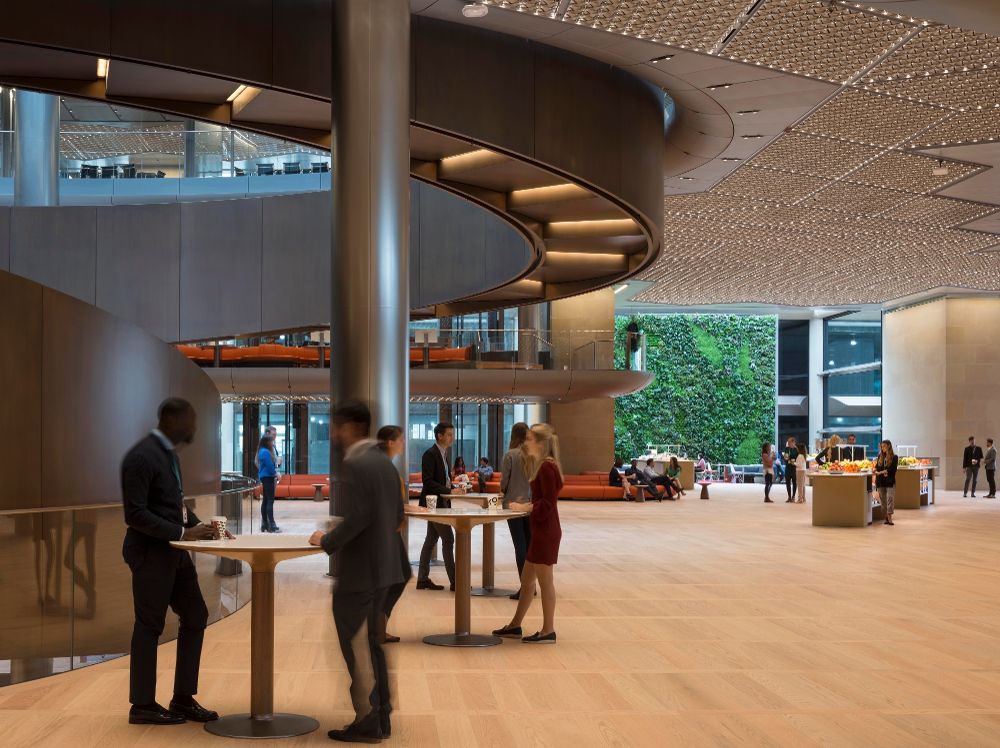
But how do you physically design that? Designing a space that can facilitate the community events where everyone can come together, whilst also providing a space for the company to express identity and the identity of the individuals within the company, will be key in generating sense of belonging and pride and therefore improved wellbeing. So whether that’s your impressive triple-height atrium which proudly displays the company and the products or services you’ve contributed to, a beautiful roof-top balcony where you can unwind with colleagues, or a kitchen table where everyone comes together, you are giving your employees a sense of place and a sense of belonging that’s a lot harder to generate when everyone’s a thumbnail on a screen. Some examples of these spaces are The Bloomburg Building, London and Gusto Headquarters in San Francisco.
Secondly, for many of us offices can provide respite from the increasingly hot days we experience during the summer in the UK. Our workplace can provide the perfect indoor temperature and humidity for working (ideally between 40 – 60% humidity and around 23 degrees for an office), the perfect lighting for productivity and workstations that support good posture. As the effects of climate change become ever more apparent (and a much more in-depth post will be exploring this soon) it’s becoming clearer that our traditional UK housing stock cannot provide the same optimum levels of comfort in the way that a well-designed office can. Building Regulations and the lower BREEAM targets provide the basics to conform to, however workplaces can and should be going above and beyond in both sustainability and wellbeing certifications to provide the ‘gold standard’, the WELL building standard being the certification that shows the highest level of commitment to the wellbeing design.
Finally, how do we design spaces to encourage creativity, collaboration and innovation? Interestingly the Gensler 2016 UK Workplace Survey showed that in more creative firms, hybrid working was the optimum model to encourage creativity and this was well before the pandemic. Therefore it is clear that in some instances allowing flexibility and control over where and how you work has been encouraging creativity for much longer than the last two years. So if being in the office some of the time encourages creativity, what should that office environment look like to capitalise on that? It certainly combines the above points of providing optimum comfort and support, alongside spaces that allow you to feel like you belong and have a sense of place. Then it very much depends on your industry and what collaboration looks like, however providing the space for a variety of different tasks, where tools such as whiteboards and pinboards can retain brainstorming sessions, where integrated technology allows for collaboration with others, with the acoustics and separation to match. This point is much more bespoke to the particular company and therefore should be treated as such.

These three points are a small portion of what makes up a successful workplace environment, and for some these might not work at all. However what is important is that we make these spaces worth the employee-consumers while. If we are to spend the time commuting to the office and leaving the ease of rolling out of bed straight to the desk, we’re going to need something to excite and inspire us.
Supporting or facilitating the company culture physically will strengthen the culture, and make for a more engaged workforce where employees feel like they belong, contributing to the reduction of staff turnover and increasing staff retention.
Therefore, we need our offices to provide the sense of community and culture which so many of us lost throughout the pandemic; we need to learn from our seniors and understand how to interact at those more senior levels in order to advance our own careers, and we want to have interesting and stimulating interactions with people because we are human and being part of a community is our superpower – yes we can make do, but I think we can and should do better than that.

 Project Wellbeing